

Indroduction
Infrastructure is the essential physical frameworks of a business or country, for example, transportation, correspondence, sewage, water and electric frameworks are on the whole instances of foundation. These structures are tending to be a high-cost asset and are vital for the country’s economic development and prosperity. The infrastructure of the Indian economy plays a key role in the growth and prosperity of the country. The Infrastructure of India focusses on transportation, banking and finance, communications, energy resources, mining, and urban infrastructure. India’s Infrastructure was started by the British and it was done to the extent there needs to be able to transfer all the raw material and finished goods to the United Kingdom from India. However, after Independence, Indian governments was not able to spend much on infrastructure, as they had more instantaneous needs like meeting the basic needs of a big population that barely was able to avoiding a famine until the 1960s. However, some huge dams, energy plants, Nuclear Installations etc. Were created initially. However, developing road transportation system was always the last priority of the Indian government until 1990s. India is a country with vast geographical expansion and it’s been 72 years after independence so it needs more time for the development of infrastructure which can accommodate its social, economic, and cultural diversities of the country.
Reason for the Slow Development in Infrastructure are
One of the core reasons for slow development of infrastructure is large population of the nation.
Another reason is its democracy system which delays the process of developing infrastructure but this delay also helps in avoiding major mistakes in building up a good infrastructure system which can help in country’s economic development and prosperity.
But India is not really ‘poor’ in infrastructures considering mega multiuse dams, golden quadrilateral super highways, one of the greatest railway systems of the world etc.
The lack of suitable infrastructure has tugs down India’s GDP growth by 1-2 per cent every consecutive year. It argues that public investment will have to be accompanied by private sector investments, in PPPs, to enhance the physical infrastructure sector of the country.
India is the fourth main economy in the world, a key Factor which is obstructing its growth and progress is due to the lack of world class infrastructure facility. Research suggests that this lack of adequate infrastructure can reduces India’s GDP growth by 1-2 per cent every consecutive year. Quick development of the Indian economy in these flow years has put an expanding weight on physical foundation, for example, power, streets transportation, railroads transportation, ports, water system, airplane terminals, water supply and sanitation frameworks, the majority of this which is as of now being experiencing a critical insufficiency.
Physical infrastructure is responsible for the growth and overall development of an economy. The goals of comprehensive growth and 9 per cent growth in GDP can be accomplished only if India’s infrastructure deficit is overcome. Infrastructure development will also help creating a better investment environment in India.
To create infrastructure facility of the nation, the administration is bound to audit issues of budgetary designation, duty approach, monetary impetuses, private segment support, and public – private organizations (PPPs).
There are lots of issues that are required to be considered in different infrastructural fields. To start with, the gap between energy production and demand is moving both production and overall growth. Another worry is the transportation sector; while road transportation is the backbone of the Indian transportation infrastructure, it is insufficient in terms of superiority, quantity, and connectivity. Furthermore, public aviation and ports desperately need modernisation. It is normal that the private sector will keep on playing a significant job in development transportation framework. Be that as it may, the resources required are a lot larger than what the public sector can convey.
Government of India is approaching up with many new important infrastructure projects such as Sagarmala project, Mumbai trans-harbour link, Bharatmala, railways development in Arunachal Pradesh, Setu Bharatam, smart cities, Inland waterways, etc. However, interruptions in owing to fund crunch or land acquisition and other legalities might lead to cost overruns and mishaps.
Near 200 road projects at a total of Rs 1.5 lakh crore may see achieve by mid-2019 or that is what the Indian government is aiming at. Maharashtra has 52 of such projects, Uttar Pradesh has 45, Rajasthan has 28 and Gujarat, Madhya Pradesh have 27 and 26, correspondingly. However, as earlier records display, not all of them may not be accomplished by 2019.
Though hundreds of infrastructure missions are ongoing, the deficiency of infrastructure has caused much harm already. Don Lambert, Senior Finance Expert (steelguru, n.d.), South Asia District Department of Asian Development Bank says, “infrastructure is the elephant in the room. India’s economy has many strengths which are dynamic industrialists, political steadiness, a young labour force. However, its lack of world-class infrastructure is holding back progress and development.” On one hand, the Indian government has recognised and consequently, these projects have been declared, on the other, lack of a dedicated institution like a bond guarantee fund which would have promoted efficiency, this lack may generate a ‘mission drift’, in the words of Lambert.
According to me the deprived infrastructure is amongst the major hurdles faced by the Indian government’s striving program known as “Make in India,” which objectives is to expand the nation’s manufacturing abilities and support high growth for generating employment. We believe commercial growth and investments can be vulnerable if the Indian government flops to close the infrastructure deficit, which according to some experts it is estimate to costs about 4%-5% of GDP due to inadequacies. Infrastructure growth may not only assist to remove some of these inefficiencies contributing instantly from economic progress but also support stronger long-term expansion.
Infrastructure growth has not kept up with the growing needs of the economy. Later on, 2007, the nation slipped its 14 ranks to 81st worldwide in terms of overall class of infrastructure (www.statista.com, n.d.). In a recent account, the World Bank estimates that India might be require up to 1.7 trillion dollars to close its gap in infrastructure development. Such a massive task cannot be borne by the Indian government on their own and will require more public-private partnerships and private investments.
There are no sources in the current document. infrastructure financing sector totalled only 2.4 % of GDP per year on average from 2009 to 2013.
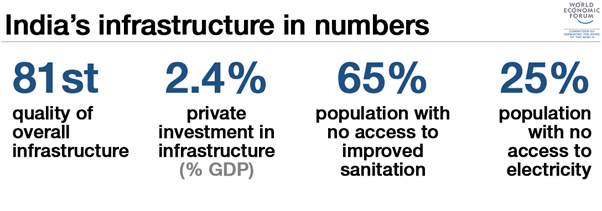
A quarter of Indian citizen still don ‘t has access to electricity and just about one – third of the urban population are living in slums. 65% of the people does not have access to better sanitation and access remains unequally distributed. This is also the case for clean drinking water.
India’s energy infrastructure which is one of the weak points, seems to be turning an angle, but transportation infrastructure still faces overwhelming volume constraints. We believe implementation capability will remain the major challenge for transportation infrastructure schemes based on lessons learned from the energy sector. The Indian government has to lead by example by spending first and demonstrating the ability to implement the projects. Sustained plan improvements, trust in maintainability of monetary development, and foundation extension will be vital to draw in private area investment.
Conclusion
I believe enough capital should be accessible for commercially viable missions as contractors’ financial health progresses, capital markets could able to gain greater trust in the contractors’ performance ability and banks improve capital and craving for infrastructure lending. I believe cautious project selection and appropriate risk premiums by developers and investors to build in strong on secular development (even if India seem to be the fastest growing largest economy–for now) would be key for sustained infrastructure expansion. Infrastructure may yet again be India’s obstacle, or if done right, it could be the key to achieving the country’s full economic potential.
Reference
 Aniket Blog
Great…its is not only Productive but also very useful and informative…..Axesome blog!!!
LikeLike
Good Work Informative Research
LikeLiked by 1 person
India has been facing low infrastructure issue since the age of independence. But now india is movong ahead with its strategies.
Thanks for writing an article about it as it is higly neede to make people aware.
LikeLiked by 1 person
The article has been written nicely! It gives a good information abt the low level of infrastructure in our country. Keep up the good work bro!
LikeLiked by 1 person
Hey great work…very informative
LikeLiked by 1 person
Great article. It seems like a thorough research has been done on the topic. Hope the government will focus on infrastructural development
LikeLiked by 1 person
Great job bro. Well written and good research done!
LikeLike
A very logical and coming topic that is only going to increase its importance.Glad to see people are discussing and talking about such topics that are going to be extremely impactful in the future…..
LikeLiked by 1 person
Very well analysed!
Loved the insights on the data available…
Well done, keep coming up with such articles!
LikeLiked by 1 person
Really informative, good job with the research. 👌👍👍
LikeLike
I appreciate your critical thinking and the way you have explain the whole thing the only point you can add as challenges for lower infrastructural growth is that there is a lack of quality education and vocational training amongst the large youth of India….rest is all fine… keep up the good work.
LikeLike
Great Aniket…..your blog on infrastructure is highly informative. I really appreciate your analytical approach to explain the criticality of the subject in simple manner. We should try to bring government attention in this important topic on national interest. All the very best to write many more blogs in various subjects during coming days!
LikeLike
Aniket very good.India is progressing and has improved a lot in infrastructure… I think corruption is the weak link ….Keep writting!
LikeLike
Good job Aniket !
You had successfully drawn a clear picture of the importance of infrastructure on our Economy through your article .
It’s very informative.
Keep going !!!!
LikeLike
That’s some good stuff and is also very well explained. Keep up the good work
LikeLike
Very simple and concise points- was a good read that aimed to get across a point with no confusion or unnecessary information. Keep up the good work!
LikeLike
Well researched and very much informative. Worth the read and your blog has inspired me to read about this topic more.
LikeLike
Well written and well thought out! The development of technology and infrastructure are two crucial points which, if improved upon, would solve not only the problem of national/per capita income, but the pressing issues of pollution and traffic as well. It’s time to start moving forward!
LikeLike